This first post in this series focuses on the obvious first question to address:  are we dealing with a Louisiana sales tax issue or a Louisiana use tax issue (or perhaps both)?  Which tax is applicable, and which Louisiana statutory tax provisions are to be utilized?

The interplay of sales tax and use tax in

Today, in a case of first impression that has captured national attention, the Louisiana Supreme Court held in a 4-3 decision that Wal-Mart.com (an online marketplace facilitator) is not required to collect and remit Jefferson Parish sales tax on behalf of its third-party sellers.

See Normand v. Wal-Mart.com USA, LLC, 2019-263 (La. 12/29/19), __

The date and time are now set for the much-anticipated oral argument of the Wal-Mart.com “marketplace” litigation matter in Louisiana’s highest court!

On September 4th, at 2:00 PM CT, the Louisiana Supreme Court will hear oral arguments of the taxpayer, Wal-Mart.com, and the local tax collector, the Jefferson Parish Sheriff’s Office (JPSO).

A link

Monday’s meeting in Baton Rouge of the Louisiana Sales and Use Tax Commission for Remote Sellers (the “Commission”) included two pieces of good news for just about everyone involved in or affected by the state’s effort to centralize the collection and remittance of sales taxes for remote sales. Unfortunately, there still remains a

Louisiana’s Uniform Local Sales Tax Board (“ULSTB”) has now issued its adopted regulation at Louisiana Administrative Code (“LAC”) 72:I.105 (“Voluntary Disclosure Agreements”) regarding a uniform voluntary disclosure program and corresponding uniform voluntary disclosure agreement (VDA) for Louisiana local sales and use tax purposes.  The final, adopted regulation contains the same language as the prior proposed

The Louisiana Sales and Use Tax Commission for Remote Sellers (the “Commission”) has now officially issued its second information bulletin – Remote Sellers Information Bulletin (“RSIB”) 18-002 – which provides a general definition for “remote sellers,” as well as further administrative guidance regarding current and future registration, collection, remittance, and reporting requirements for “remote sellers.”  

As word spread about the Supreme Court’s opinion in South Dakota v. Wayfair, Inc., Dkt. No. 17-494, 485 U.S.        (June 21, 2018), tax administrators around the country popped open bottles of champagne and began toasting the end of the “physical presence” substantial nexus standard.  The sounds of celebration were, at least initially, particularly deafening in Louisiana, with its sixty-three (63) autonomous parish taxing jurisdictions that levy, administer and collect local sales and use tax on behalf of numerous cities, towns, districts and other local jurisdictions.  Remote sellers might have considered downing a drink or two to drown their sorrows at the thought of potentially having to navigate the complex systems of state and local sales taxes in Louisiana.
As tax administrators continued to read the Wayfair opinion, however, a sobering reality began to set in that, at least in the short term, Louisiana’s various taxing jurisdictions are in no better position to force remote sellers to collect and remit state and local sales taxes than they were before the Wayfair decision (and perhaps even a worse one).
Continue Reading Not So Fast: Louisiana State and Local Sales Taxes in a Post-Wayfair World

In December 2017, the Mississippi Department of Revenue finalized a new sales and use tax regulation addressing remote sellers and establishing a $250,000 bright-line nexus standard. The department began that process in January 2017 by issuing a proposed regulation and refined it following a public hearing held in February. The regulation positioned the state to take advantage of any repeal of Quill’s physical presence test, but the department stated it would not enforce the new rule until the Supreme Court took that step. Now that Quill’s physical presence rule has been invalidated in Wayfair, taxpayers should expect the department to move forward with these remote-use tax collection efforts. The following information should help summarize Mississippi’s current rules and identify several important details and questions that have yet to be answered.

Statutory Background

Mississippi law [Section 27-67-4(2)(e)] has long required remote sellers to collect use tax if they have nexus with the state by “purposefully or systematically exploiting the consumer market provided by this state.” This could be accomplished “by any media-assisted, media-facilitated or media-solicited means, including, but not limited to, direct mail advertising, unsolicited distribution of catalogues, computer-assisted shopping, television, radio or other electronic media, or magazine or newspaper advertisements or other media.” This collection obligation is contained within the use tax code, not the sales tax code as may be the case in some other states.

Regulatory Bright-Line Rule

The final regulation specifies that sellers have a “substantial economic presence” if their sales into the state exceed $250,000 for the prior 12 months. The original proposed regulation would have based the sales threshold on the prior calendar year, so this change means sellers should track Mississippi transactions on a rolling, monthly basis if they are not otherwise registered. Unlike other states, Mississippi does not specify any minimum number of transactions to create nexus, and Department of Revenue officials have stated informally that a single transaction may meet the requirement when coupled with the other “market exploitation” criteria discussed below.
Continue Reading The Taxman Cometh: Mississippi Sales and Use Taxes in a Post-Wayfair World

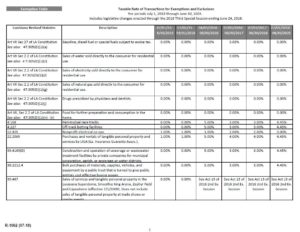
The Louisiana Department of Revenue has now issued a revised “Taxable Rate” chart (Form R-1002) to provide the Department’s understanding of the new Louisiana state-level sales/use/lease tax rates following the Louisiana legislature’s enactment of the sales tax revenue measure Act 1 (HB 10) in the recently-concluded third special session of the legislature, effective July 1,