Years ago the Mississippi Legislature “borrowed” certain sales, use and payroll tax collections from a subsequent fiscal year to close a then-current year budget gap.  Because Mississippi has a June 30 fiscal year end, the legislation required certain taxpayers having a monthly tax liability of $50,000 or more to accelerate 75% of their June tax

Reposted from Mississippi Lt. Gov. Delbert Hosemann’s Facebook page:

COVID-19 Update: By agreement of Lieutenant Governor Delbert Hosemann and Speaker of the House Philip Gunn, the Mississippi Legislature will reconvene the 2020 legislative session on Monday, May 18.

The Legislature recessed its 125-day session temporarily on March 18, following the governor’s issuance of a

The Mississippi Secretary of State’s office has now issued its new Remote Notarization Order Guidance following Mississippi Governor Tate Reeves’ Executive Order 1467, which modified the in-person requirement for notarization temporarily.

According to the new Remote Notarization Order Guidance, effective immediately, and continuing throughout the period of the State of Emergency Proclamation as declared

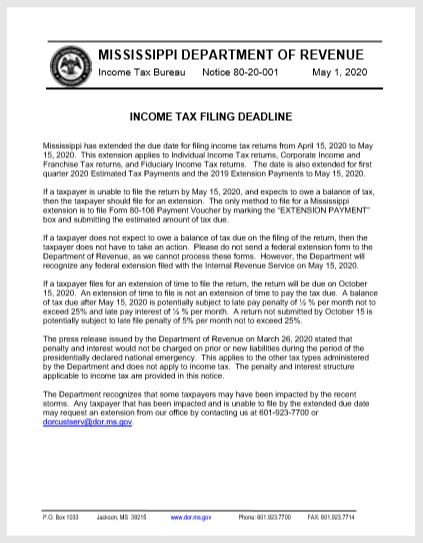
This afternoon the Mississippi Department of Revenue issued a notice containing updated information related to multiple extended filing deadlines and audit procedures. Among the changes are the following:

  • Income and franchise tax filing deadlines remain extended to May 15 (no change from prior notice)
  • Sales and use tax return filing deadlines remain unchanged, but

Jones Walker SALT Team member John Fletcher recently presented at the Council on State Taxation’s Sales Tax Symposium in Atlanta, Georgia. John’s panel, “Hot Topics – East of the Mississippi” covered litigation and legislative issues for companies with extensive operations east of the Mississippi River. Topics included the controversial recent trend by states to impose

JW SALT Team member, John Fletcher, published an article in the Mississippi Business Journal on how the US Supreme Court hearing of South Dakota vs. Wayfair will affect internet industries and small businesses in Mississippi.

The Court wrestled over whether it should abandon or uphold its longstanding physical presence requirement and, if oral

“Substantial economic presence” nexus standard formally embodied in regulation.

As expected after recently having filed an economic impact statement, the Mississippi Department of Revenue on November 1 filed its final remote seller use tax regulation with the Secretary of State. The new regulation will be effective December 1, 2017, and contains numerous changes from the